
"I Wanted to Make Sure That There Were A Lot of Bells"

An interview with the director and lead of Revelations of Divine Love (2026).
by Chris Randle
How small a hollow could hold the mysteries of the world? In 1373, deathly ill, the English mystic Julian of Norwich received a series of visions or “shewings” from Jesus Christ. When she opened her palm to reveal a hazelnut, he told her: “It is all that is made.” Julian marveled that such a tiny thing might encompass so much, and Jesus said: “It lasteth and ever shall, because God loveth it.” Perhaps God loved her too, because she recovered to describe her experience under the title Revelations of Divine Love, the earliest surviving book written by a woman in English. Caroline Golum’s new film, also called Revelations of Divine Love, uses Julian’s text as a well of images for its own miniature of the Middle Ages.
Julian wrote the book while enclosed inside a cell, one of the medieval recluses known as an anchoress (the men, at times significantly outnumbered, were called anchorites). Anchoresses withdrew from society to contemplate God, but unlike hermits they often did so inside urban centers, counseling visitors at their windows. Golum recreates this world of nuns, peasants, and countesses on tactile, theatrical sets, working with a small budget and a large community. The film is sincere but never pious.
After Revelations of Divine Love premiered in New York City last month, I spoke with Golum and her star Tessa Strain, an old friend. So much of it hinges on Tessa’s face, isolated, ever-searching; a face to spite the Byzantine iconoclasts.
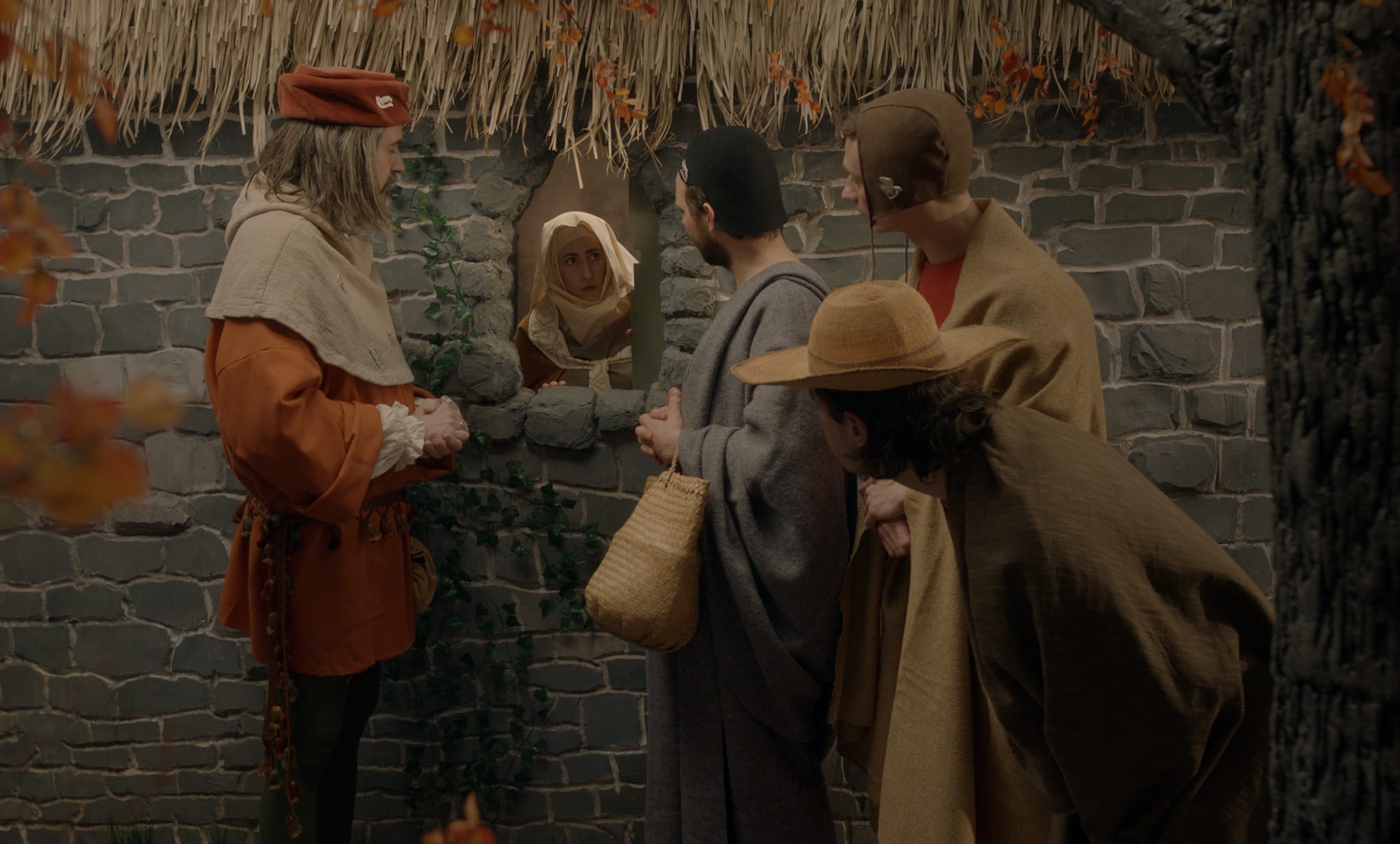
What made you look at Tessa and see a 14th century anchoress?
Caroline Golum: I know Tessa is a great actress because we worked together in a production of Midsummer Night's Dream when we were in elementary school, and I was really taken by her naturalism and her ability to embody the period of Elizabethan England, standing in for ancient Greece. And we'd also worked together before on a film that I made that no one will ever see. It's like a 50-minute movie that didn't really pan out, but I just thought, Who would be game for this and who would be able to do it? Who do I trust enough? And who trusts me enough? So naturally, it was Tessa. And she has a classically beautiful face, the face you would see on a coin or in a painting.
The images from Julian's prose are so elaborate, as if she was returning to them over and over. I'm thinking of this description of the scourging of Christ, which she describes like a horror movie: “The fair skin was broken full deep into the tender flesh the sharp smiting all about the sweet body. So plenteously the hot blood ran out that there was neither seen skin nor wound, but as it were all blood.” Mystical texts often present themselves as some esoteric secret, but her writing is more open and more generous than that. What was it about her prose that resonated with you?
CG: I never encountered anything like Julian's writing before, I'd never read any kind of account like this—admittedly I’m not up to date on all the mystic texts. I am interested in mysticism, obviously, and I'm fascinated by it, especially medieval mysticism, because it was such a prevalent part of people's quotidian practice and their faith and their understanding. Julian's text in particular, what makes it special is that it's the earliest known account of a woman's mystical experience, right? So for me it flew in the face of everything that I thought, that I understood about what it was to be a woman in this era, in the Middle Ages. It's pretty remarkable that this woman had this crazy experience, that she wrote it down, and moreover that she wasn't burned at the stake. And again, this is such a contrast to what we've been taught to understand about the 14th century. And a lot of the making of this film and researching this film and reading Julian's work was about decoupling my understanding of the era from how it actually was, and reassessing it. I find her prose style to be incredibly beautiful and really rich. Obviously I have an easier time with the translated modern English text, not the Middle English, but Middle English is really beautiful too.
The impetus for this was, I want to put these [visions] on screen, and then it ballooned from there into being a larger film about this community around this particular place. And it's also great writing, even when she's not describing the splendor of the blood or the suffering or what she experiences with the hazelnut or whatever, the theological stuff that she talks about too, like that we are clad in God as if it were our clothing, or that Christ is our mother and sustaineth us and nurses us. This is stuff that, if money were no object, we would have been able to dive into a lot deeper in the movie, and unfortunately we couldn't. But I think that we do a really good job of choosing visions that lend themselves to the cinematic treatment, and that give you a nice little survey of what Julian was about, what this experience meant for her.
TS: I think on my end, I made the decision pretty early on not to get too in the weeds with research. I didn't want to get too in my head about it. I didn't want to come in with a lot of preconceptions. And I sort of decided that Caroline was going to be my translator, both as a friend and also artistically. So for me, it was really what was in the script, a lot of which is taken directly from her writing and her language. But I didn't want to be asking, where is this, what about this?
But what made it into the script is so extraordinary too, and like so much of her imagery, some of it does have what we expect from classical medieval tales of saints or mystics, in that it's very violent and it is visceral. But then some of these, you know, the whole idea of this message of love is not really something you necessarily associate with the 14th century Catholic Church. And to [Caroline’s] point, not only was she not burned at the stake, she was welcomed into her community, she was integrated into her community, even while being isolated in this specific way. That was meaningful to me, this idea that there was a hunger for her message, and that people were ready to hear it, or willing to hear it, or it made them think—yeah, that was moving to me.
That is one of the paradoxes, right? One of the few routes for women to become an authority in this society was through this extreme seclusion.
TS: And I think a lot of the tension in the movie—it's between faith and doubt, but also too between privilege and obligation. To what degree is withdrawing from the world something that she owes God, versus what she owes her community? How she navigates that is an ongoing source of complexity for her, and I think Caroline’s script conveys that really well, having her encounter different types of people, and encounter different types of crises, and to wonder if she's insulating herself too much, if she’s interfering too much. To this day there's always a question of, what is my role in the greater world, and certainly in a time of crisis you have to make decisions about it every day, and you'll never be sure if it's right. And to see someone who has such extraordinary conviction navigating those questions as well, it lends itself to that broader implication.
So much of her personal life is unknown too, like, we don't even know whether she took the name Julian from her local church, because it was a genderless name back then. Did that color your performance at all, that lack of—
TS: Yeah, the unknowns of it. I think there was certain liberation in that Caroline's perspective—she wasn't asking an intense naturalism of anyone, we're in this very artificial environment, so it's like you want to be authentic to this vision, and not necessarily to a gritty reality.
CG: But also, what would that authenticity even look like when we have people coming and being like, “Hi, I'm an ale wench.” She's like, What the fuck, that's so phony.
TS: Yeah, no. It was just finding some kind of emotional or spiritual truth moment to moment. But there were things like, when I thought about her relationship with her mother … Why is her mom okay with this, that she has been, in some respects, indulged for much of her life, and that she's created this challenge for herself that her mother's unable to understand as well.
CG: “Why do you want to go to art school?”
TS: No, exactly [laughs].
CG: There are also a lot of speculative ideas about her life, speculative biographical details that I just, for the sake of simplicity and keeping the focus of the story on Julian, her visions, her decision, and the people around her, I didn't really feel like excising, and we nod to it in other ways. Like, there's some theory that she was married and had children and they died in the plague, and that's part of why she became an anchoress. We don't know. I didn't want her motivation to do this to be, oh, she's left adrift by the death of her family, and has no purpose, and now she's an anchoress. I didn't want to deal with that. Valéry [Lessard’s] character, Sybil, that’s the homage to the woman who loses everything in the plague. I like to think that maybe she becomes an anchoress. Or what did we decide, that she makes a second wealthy marriage and doesn't have any more kids? Yeah, we're filling in her little backstory.
I wanted to keep it simple for economic reasons and also for narrative reasons. The other characters that get filled in there, and the other parts of the story, are not entirely based on real people, but not not based on real people. She had her confessor there, there was a curate who was assisting him, so that’s Inney [Prakash] as Curate Hamlin and Theo [Bouloukos] as Father Ambrose. We knew that she probably studied at a Benedictine priory, which would have been Carrow Abbey, because it's the closest to Norwich. So we got to fill out some of the broads at Carrow and write about them. We knew Countess Ufford existed. And we knew [Julian] had Sarah, who lived with her, her lady's maid. So there are little things here and there that you can base it on, but again, when you're working with the Middle Ages … Like, there is a lot of scholarship about this stuff. There's a lot of things that we do know, but there are just as many things, if not more things, that we don't, because it's just based on primary sources. And what do we have for Julian? We got the book, we got a mention in two wills, and that's it.
TS: And I think there's a temptation in contemporary storytelling to create these kind of emotional trigger points, or draw a direct line between this and this. And I really responded to the simplicity of—she had those visions, and that was enough. That changed her life. She spent the rest of her life writing and rewriting this text and trying to make sense of something that happened to her one time when she was about 30. And she was like, this is something that is worthy to dedicate myself to, and it doesn't come along with any sort of extra personal tragedy, but everything she experiences after that point is additive to that experience and also complicates it as well. It becomes the filter through which she sees and experiences everything else.
CG: And, you know, you don't really get the sense of—maybe you kind of do, some of the dialogue in the film. But becoming a an anchorite or an anchoress or holy hermit was not uncommon, right?
There were many of them.
CG: There were a lot.
There was an application process.
CG: Yeah, England has more than any other country at this point, and Norwich probably has more than most other cities. It was a real hotbed of mystic activity over there. I don't see it as being any different than somebody deciding to become an ascetic in today's life, right? They want to retreat from whatever is bothering them. People who move to the 5G-avoidant communities, or people who, you know, go on a social media sabbatical and they obsess over their grindset or whatever. Everybody has some sort of obsession that drives them, and they make this choice, and they follow it for the rest of their lives. And in Julian’s case, it was a religious experience, but you have to remember that people were living in a time when this was not unheard of, it wasn't sentenced to being institutionalized or whatever medicated thing that it would be today. And people are still having these experiences. I just think it's a matter of how they take shape, right? Like, are people constantly receiving transmissions from things that are bigger and more mysterious than themselves, absolutely. But what container is it delivered in, and what shape does it take? I don't know. In my instance, it's like, Oh, I'm gonna make a movie with my buddy. That’s the form that it takes for me. But everybody's different. Your mileage may vary.
For the New York premiere, you programmed a series of other medieval movies, including Roger Corman's Masque of the Red Death, which like this film is colorful and theatrical. Were you intentionally—
CG: Yes.
—trying to work against the more recent cinematic image of the Middle Ages as a drab, grimy mud pile?
CG: Let me stop you right there, 100%. Here’s why. Nell gave a really good introduction—
TS: Nell Simon, our costume designer.
CG: An absolute wonder. And you and Sydney [Buchan, assistant director] also talked about this when you did your intro for Red Death. So Nell Simon, our costume designer, did a great introduction for The Adventures of Robin Hood. And then Tessa and Sydney touched on this with The Masque of the Red Death, how most of the primary sources we have for the Middle Ages are works of art. And works of art, like, people don't want to look at shit. They want to look at something cool, whether that's the stained glass or the illuminated manuscripts. There’s beautiful fabrics and natural dyes that people are using, it was a really colorful time, and the idea that it's dun-colored and drab and dusty and gross is a fairly— probably within the last 100, 200 years reassessment, although the Arts and Crafts medieval revivalists like William Morris, those guys understood the assignment. This might even be more recent than that, I actually don't have the art history in front of me. But I know that when people want to convey that something is meager and shitty, they wash it out. There's also a larger problem, I think, with recent cinema, where everything is just shot in the LUT [lookup tables, a color-grading preset], and then nobody color-corrects it. Everything looks like shit now, except for our movie [laughter], but for real, everything is super neutral.
And I think people also, at least in contemporary cinema, when you're making a historical film, especially a film set in the Middle Ages, you want to convey that it was a shitty time, or that they were backward, or that they didn't know what they were doing. But you also want to give it that air of, big air quotes, “authenticity.” You wash it out. You don't do any kind of beautiful whatever, because then you think, Oh no, people aren't going to buy that this is realistic if someone's wearing purple or green. I hate that shit, and it's offensive to me on a personal, spiritual and aesthetic level, which is why our movie doesn't look like that. One of the most, I think, accurate aspects of our film, for all its anachronisms, is that we nailed the fucking art. We nailed the color palette, the painted floors, the fabrics and things like that. We knocked it out of the park, because that is such an important part of the era. It's how people understood things like stained-glass windows being narrative, visual allegories.
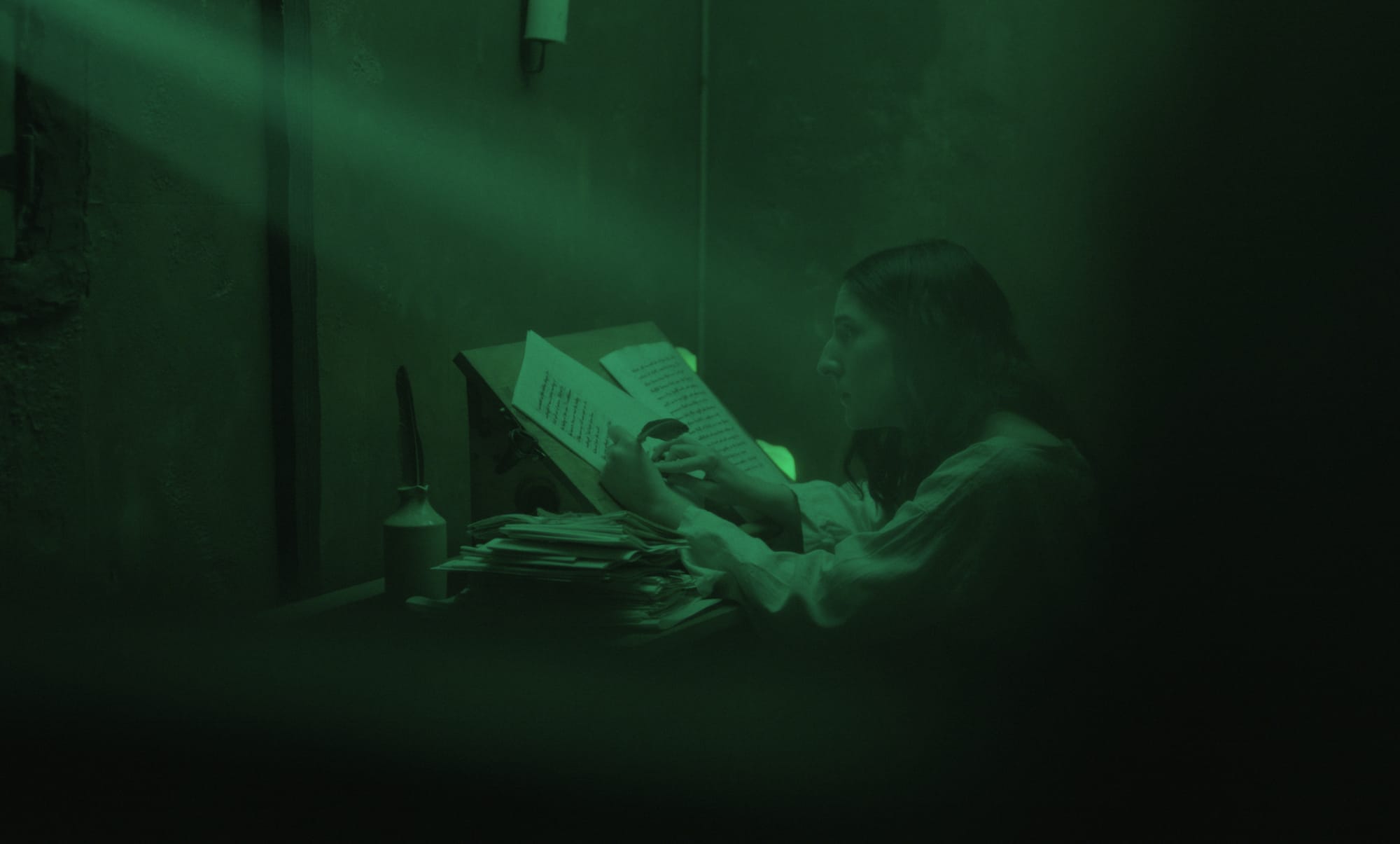
TS: The contemporary idea that strict representational realism—and again, that's taking at face value, that grit and absence of color is realism. But the charges you see leveled at a lot of medieval art is that it's a regression and that it's inept somehow, because it is more two-dimensional or representational. It’s like, oh no, those are aesthetic choices. Those really arose out of a very specific artistic trajectory. And in many ways, those were radical choices. And it's not that they didn't know better, or they didn't know how, they wanted to do something specific with that. And I feel like your choices around the film's aesthetics, making a world that felt very handcrafted and very saturated, and had some artificiality—sometimes the light was so real that I could smell snow on the wind. And then there are other times when it's just like, it's green. It's green because the plague is here and it's dark and it's scary. Letting those things coexist and feeling like, yeah, things don't necessarily need to be people just hanging out in a room, mumbling. You can have performances that are more mannered. You can have these bright colors. You can have sets that, in many ways, acknowledge their own artificiality while also being objectively beautiful. I think that’s something that's radical for our time. And some of it obviously is budgetary, but it looks beautiful on its own terms. It doesn't look beautiful for $100,000.
For Tessa, I just thought of the calligraphy. I really want to get it into posterity, what were you writing during the—
TS: I had my first calligraphy lesson over Zoom about a month before we started shooting with Lucas Tucker, really helpful. He's brilliant. He does beautiful, beautiful illuminated manuscripts. I knew I was gonna get nowhere near there. What he was coaching me on was going to be a more vernacular, casual version of that. And so I got a sense of, what's an alphabet I can base it on, how do I cheat my way through that a little bit—I'm left-handed, so that was an extra source of problems for me, because you're waiting for this ink to dry. Bless Caroline for being like, “you can still be left-handed as Julian,” because undoubtedly she would not have been allowed to write left-handed. So, a lot a lot of practice in the days leading up to it, and by the end of the shoot we got some really close-up B-roll, which I do think you see superimposed in the movie. And I was so proud of how that turned out. The only time I think I ever asked you for another take was when we did that really close-up camera, and I was like, “I can give you a perfect one.”
CG: And you did, and it looks fucking fantastic. I love seeing those dissolves, all that meaty stuff.
TS: It was such a pleasure to do. But in the wide shots, because I was having to, if the camera was on me longer I was having to produce more text, I asked our DP Gabe [Elder]: “Is this in focus? Is it visible?” And he goes, “No, why?” And I said, “Don’t worry about it.” And I wrote the lyrics to the “Monster Mash,” which Caroline still has.
CG: I do still have it.
TS: But I didn't write it on any of the parchment. The parchment only got Julian's words. That’s the good stuff.
CG: But, you know, I consider the “Monster Mash” to also be a sacred text of great import to me, so it felt apropos.
TS: Yeah, that's so true. It's about transforming within the times.
CG: Yes, it's true. And it's also about community.
TS: That's so right.
And the voice kind of sounds like Vincent Price. Can you guys talk about the Roger Corman dedication? I know you gave Caroline his memoir as a gift.
TS: Yeah, when we started shooting.
CG: The Corman mindset.
TS: Corman mindset! That was the thing that, whenever you get told no, or you run out of gas, or you run out of materials, it's like: Corman mindset. What would he do? So he felt like a godfather of the production. I mean, obviously Masque of the Red Death, was aesthetically one of our north stars on this, but just in terms of being scrappy and lacking material resources— it’s what do you make with what you have, you beg, you borrow, you steal, you work with talented people who are on your wavelength, and you give them a lot of freedom, which I think Caroline's exceptional at doing. We were all there because we cared about the project immensely.
Most of the crew are filmmakers themselves. A lot of filmmakers are among the extras too, or bit parts; you are really seeing a film community, both in front of and behind the camera. It's like we're, as you always said, we're doing it to save the rec center.
CG: Truly. While we're talking about Corman, rest in power, I do also want to mention that we had a gag on set that almost became not a gag, where we were like, Okay, what other movie can we shoot while we have this set put up? The true Corman mindset is multiple movies on the same set.
TS: That’s where we fell short.
CG: We were like, “What are we gonna do?” Werewolf movie, or what kind of nunsploitation movie can we do, et cetera. We obviously did not get it together in time, but it would have been really cool to have a totally different film that we shot on the same set.
I think Dick Miller would have crushed it.
CG: Dick Miller would have crushed it. I mean, listen, if I could bring one actor back from the dead—
TS: Can you imagine him as a crazed monk?
CG: Oh my God, I know, he'd be so good.
Last night, Tessa talked about drifting away from the church she grew up in. And Caroline is Jewish. And I was thinking about how there are certain aspects of the film, like the eroticized Jesus, that feel deeply Catholic, but I don't know how many orthodox Catholic directors would actually put that onscreen. That isn't really a question, it’s just me thinking out loud.
CG: This is the classic question of, “Hey, you Jew, why'd you make this movie?” Yeah, of course, I'm prepared to answer this. “Why would a Jew make a movie about Jesus Christ?” The answer is, Jesus is the most famous and beloved Jew who's ever lived. He has done so much to, I think, improve our reputation, our standing, maybe, or actually, depending on who you are—
TS: Keep digging.
CG: I'm gonna keep digging. I'm gonna dig this hole deeper and deeper. What's not to love? I love this stuff. Haven't you seen Hail Caesar? Like, who the fuck do you think makes these movies? I love this stuff. And, you know, is it cultural appropriation for me to make a movie about Jesus Christ, yes and no, but also it's okay to culturally appropriate European stuff. That's how I feel about the Met Cloisters, like it's all plunder, but it's European plunder, so it's fine. I was really moved by what Julian had to say about God and her relationship to God. And in my research in Christianity, as part of the research of this film, I discovered a lot about Christianity that flew in the face of my experience with it. And I'm not saying that—you know, some of my best friends are Christians. That's not the problem. Our American version of Christianity is especially venal and fascist and awful, I should say the mainstream evangelical version of it, but for every awful warmongering crusader that's in power in this country, you have just as many people from every walk of life who look at the teachings of Christ and go, I want to walk that way. I'm going to walk in his fashion. I'm going to follow this guy. I will follow him. And I will do my best to live in a state of grace. And I did not have a lot of experience with that latter aspect of it, because, like, why would I? I only knew the war on terror and those people in the Duggar family, to my great ignorance, but it's also because I'm a rootless cosmopolitan who grew up in Los Angeles and now lives in New York.
What I find really gratifying about these films is that even though they are ostensibly about Christ and Christianity, they're kind of about any obsession, right? She had a vision of Jesus, and that's what drove her to do this, but it could have been a vision of something else. Moses saw the burning bush, right? You don't need to have a recognizable figure to have a religious or transformative experience that compels you to make something. My version of this is hearing about Julian of Norwich, and then being moved to make this. So it doesn't really matter what container it takes. I think it's all one. It's all coming from the same place, it’s just in different packaging, for lack of a better term. Christ is one such example of that packaging.
TS: For me, I grew up, I guess, fairly religious, but in a very liberal church, downstream of Presbyterianism. Kind of the opposite of Catholic rigor. It did inform my moral and political views in a lot of ways, and yeah, it exposed me to Jesus. And what he's talking about is, if you got money, you got to get rid of that. If someone's hurting, you have to help them. All the things that, to me, feel pretty intuitive, how we should be structuring our society. So, you know, I did have a loss of faith in the more spiritual light, the sense of believing in God with any kind of confidence. I didn't necessarily want to participate in organized religion, but it absolutely had a huge influence on me and how I operate in the world. The idea that we're all here to serve each other, that that's what we owe each other, is a big, big part of why it matters to be alive. And if that sounds simplistic, well, that's on Jesus.
CG: But it is that simple. That's the crazy thing.
TS: That too was really compelling to me about Julian's writing and her ideas, it is in many ways, a return to that simplicity.
CG: This is purely speculative, and I say this as someone who loves watching movies about Christ. Last Temptation of Christ I'm all in the tank for; I also will go to bat, sadly, for The Passion of the Christ as a passion play, like as a medieval passion play it succeeds. I know people have a lot of problems with that movie. Those problems are totally valid, but they're also problems that are from the fucking Bible. So if you've got a problem with it, take it up with the authors. But what I like about stories of the Christ, you always see him depicted as like: “You will be my fishers of men. You are my apostles, and you will go out and preach this good word.” But was the goal for Christ, for the anointed one, was the goal to be like: “And you're going to make all these people organized as a state that uses faith to fight other countries or to oppress other people.” I don't really think that was part of the agenda for the Nazarene. I think it really was just, “This is the message, go spread it out there, get it out there and tell all the rich people to give their money out.”
Both of you managed to make Julian's life modern without ironizing it. One of my favorite performances in the film is Sister Agnes, because it’s so far removed from the clichés of medieval cinema.
CG: She has a great Rochester accent, Hanna [Edizel]. She's really cool. I love her. She's incredibly well-cast and well-placed in this film. She gives such a great performance. Rochester accent, roots growing in from a double process, just classic hot girl shit, and that’s what Sister Agnes would have been like back then.
Last year at Anthology [Film Archives], I finally saw Peter Watkins’s docudrama about the Paris Commune, which makes use of its own anachronisms, and the cast members repeatedly break character to discuss the meaning of the Commune in their own lives. Did you guys have a similar experience in this film about plague and class struggle and suffering?
CG: I didn't set out to make a topical movie, but the topical aspects of it kind of emerged from the aether in a way that I find really spooky and upsetting. But if it wasn't the 14th century, it would be another crisis in another century, the entire history and story of humanity is just crisis after crisis after crisis after crisis, despite the fact that these crises continue to happen. I mean, for fuck’s sake, they were coming out of an ice age in the Middle Ages, you know what I mean? Even the ecological crisis is not something that emerged within the last hundred years, people have been dealing with one fucking thing after another since we were walking upright and organizing ourselves. It's how people deal with these crises, I think, that differs from moment to moment or era to era, but also how they are the same, right? What do people do when shit gets heavy?
I was reading recently about how there have been all these meteor and asteroid sightings lately, and what's the deal? What's the government hiding from us? Where is this coming from? But it's pretty well-documented that in times of tumult, people are more likely to identify these things or spot them because they're looking up. They're looking up at the sky looking for signs of warning. So…I don't know. I mean, in a hundred years, there'll be another horrible thing that people are gonna be making movies about, or maybe it'll be about the Spanish flu. We’re far enough away, I think, from the Black Death and the Peasants’ Revolt that we can draw a parallel between the two things pretty neatly, like from this film. And what transpired all those years ago, it maps, sort of, but I wouldn't say it's like a one-to-one, exactly.
Yeah. I really appreciate how it's not that sort of facile—the outbreak scene is not staged like Covid. It's staged like Prince of Darkness.
CG: Yeah, that’s on purpose. We love Prince of Darkness. I did want to make a movie about today set in the Middle Ages, and I did want to make a movie about the Middle Ages that kind of feels like today, too. And there are little things that make their way into the film that are residual parts of my season one of Covid feelings, like the ambulances. I live near a hospital, and so I heard an ambulance every five minutes. I wanted to make sure that there were a lot of bells to signal that people were dying all over the fucking place. I don't know if that lands in the same way, but that was how I wanted to work that out for myself. People just drop dead all the damn time, and it doesn't matter how enlightened or how scientifically sophisticated we think we are in our modern era, there's always going to be the mystery of: Why do bad things happen to good people? No one can solve that. You know what I mean? Some people have theories, but there really is no answer. It's kind of a downer note to end the interview on [laughs]. Tessa, take it away!
TS: Oh, cool [laughs]. Well, I'll take a different angle on approaching that same question, which is a more personal one, and not to be that asshole who's like, “every film is implicitly about filmmaking.” But I mean, this is—it’s all over it. To do something like this is an act of faith. The metaphor is not lost on me, that me, Tessa Strain, I received a call to do something I wasn't sure I was equal to and that I just bought the ticket and took the ride. The first scene that we shot was me being anchored, and that moment of her realizing, oh shit, I'm really doing this was also my moment. That happened and it's on camera. There were so many off-ramps you had over the years where you could have dropped this project entirely, and the faith sustaining it was a big part of that for all of us. And I think there was this collective belief in the movie and what the movie was trying to do, which I think is not common. I think it helps that it was a small set, and you're working with a crew of about 16 people, but it's all true believers there. Everyone really felt like we were a part of something that was meaningful and necessary. So a lot of those experiences, I do think you are seeing pretty authentically on the screen, it ended up there.
And two, by virtue of having so many things so handmade and so collectively done, it's, you know, it takes a lot of hands to build the cathedral. It's not something that really can be approached singly. And that's part of what Julian's story within this film is as well, is that she's isolated but she’s not, she is in this greater world. And I love how much of the film shows the world around her. I love that it's not just sticking in her cell and whoever pops by her window. There's an entire ecosystem that surrounds her, socially, politically and spiritually, and I think that’s a meaningful thing to see. It was a meaningful thing for me to experience. Like, I'll go on the record and say this movie changed my life, I emerged a different person, and I came out of it being like, “Yeah, I know why she spent the rest of her life obsessing over this one thing that happened to her in her early thirties.”.
CG: That's literally how I ended up making this fucking movie, is one thing happened in my early thirties. I was, like, “I’m obsessed now.” I want to add one thing so that my last word is not super doomer, which is, re: the pandemic, season one of the pandemic. You know, a lot of people split. Lot of people left town, right? And it was also, I think, a moment for a great many people living in cities where they realized, okay, the government isn't going to fix this for you. And I'm not like a conspiracy theorist, I just think that the government fucks up constantly, and doesn't actually exist to protect and serve people. It exists to extract as much wealth as possible from working people. So what I think a lot of people realize is, it's not the government that's going to come in and help you with this. The government's not going to help you pay for those groceries. It's going to be the mutual aid group in your neighborhood, right? The government is not going to make sure that you get your PPE. It's going to be a PPE drive at the library or the school.
The government is not going to take care of you, but you know who takes care of you? We do. Like, we keep us safe. This was the chance. This was the mantra that we were all going after, and however you feel about the efficacy of the social movements that emerged in the first season of the pandemic, I think for a lot of people, it’s a very eye opening experience to look around and say, “Oh, the structures of power and the institutions that I believed were acting in my interests are, in fact, acting in their interests.” And the only real certainty that you have is one another. You're more likely to survive a large-scale disaster if you have other people that you can collaborate with and pool resources with, than if you're just a guy hiding out in a Fuhrerbunker in a suburb somewhere. So let me just leave it at that. You can't do it alone.
Comments ()