
Teen Agency: 'Real Genius' Against the War Machine
by Will Craven
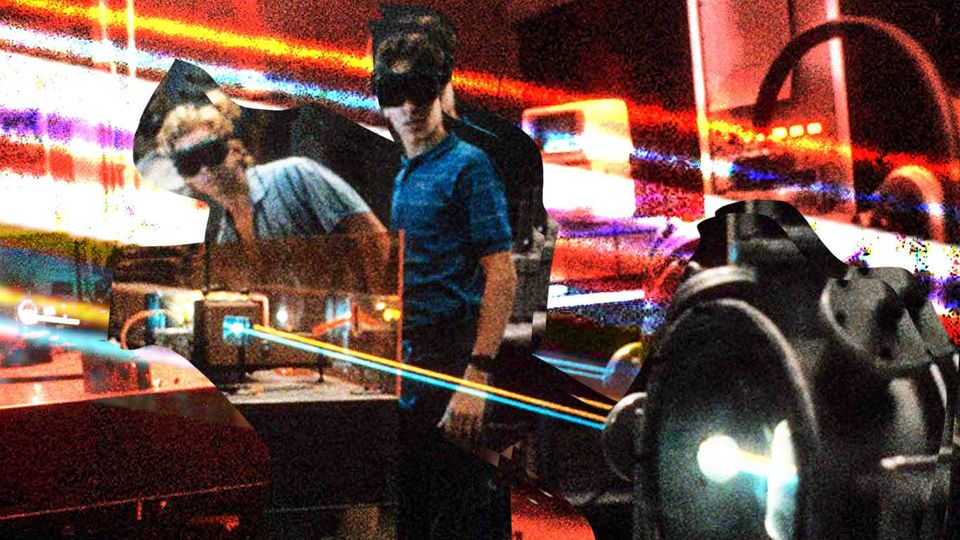
Martha Coolidge’s 1985 film Real Genius is thorough-going teen comedy. Set at Pacific Tech, an elite public university based on Caltech, it tells the story of three campus “geniuses”—Mitch, Chris, and Laszlo—through relentless quips, pranks, and sophomoric jokes. It was also part of the teen film boom’s least likely sub-genre—the geopolitical melodrama. Alongside Taps (1981), War Games (1983), Red Dawn (1984), Falcon and the Snowman (1985), and Project X (1987) [1], Real Genius put teen agency to the test in Cold War contexts.
Whereas most of these films are colossal bummers, cautionary tales of youthful innocence straying too far into the adult sphere, Real Genius is about taking on the military–industrial complex—and winning. Its opening credits depict a series of weapons schematics over the course of human history, from knife to ax to arrow to gun to missile. That this sequence is set to the tune of Rodgers and Hart’s “You Took Advantage of Me” quickly establishes a theme: science and technology run in tandem with violence and exploitation. Real Genius is about college students getting even with the war machine.

The film's eponymous geniuses come in three types. Mitch (Gabe Jarrett) is a 15-year-old freshman nerd with record-setting placement scores and an obedient disposition. He rooms with an ex-nerd, senior Chris Knight (Val Kilmer), a trickster figure determined to party. Their third is Laszlo Hollyfeld (Jon Gries, of White Lotus), the school’s legendary brain from the 70's who suffered a nervous breakdown and secretly lives in a steam tunnel beneath the dorms.
The film is largely Kilmer’s, who died last year at age 65. He was unpredictably artful in many films, from tour de force debut Top Secret (1984), to his career-making ten minutes of screen time in Top Gun (1986), to his swashbuckling Madmartigan in Willow (1988), to his Jim Morrison and his Doc Holliday: in each there was something mannered, something sincere. Real Genius works on multiple levels because of his ability to be waggish and puckish, principled and daring, in scene after scene. (With more to come, of a sort: Variety has reported that an AI hallucination of Kilmer will appear in a movie called, amazingly, As Deep as the Grave.)
Kilmer's foil throughout Real Genius is William Atherton (iconically smug in Ghostbusters (1984) and Die Hard (1988)) as Professor Jerry Hathaway. Under his supervision Chris and Mitch are hard at work on a laser project; what they don’t know is that Hathaway has them working under U.S. State Department deadlines for weapons testing.
When other students bully Mitch, he decides to quit school. Chris finds him packing his bags and urges him to stay, warning that running away from school could mean running away from everything:
Mitch: “What, you think if I keep going like this I’m going to end up in a steam tunnel?”
Chris, urgently: “Yeah. You are.”
Chris explains that Laszlo suffered a breakdown upon learning that his work was being used for war. To avoid the same bleak fate, he proposes that Mitch engage the world on more principled terms. Their first task: get even with the bullies on their lab team. “It’s a moral imperative,” he argues. Though neither he nor Mitch are yet aware of the military dimension of their coursework, they are building the moral framework to respond to it.
In fact “building a moral framework” unites Coolidge’s teen trilogy of Not a Pretty Picture (1976), Valley Girl (1983), and Real Genius [2]. Directorial debut Not a Pretty Picture, re-released last year by the Criterion Collection, tells the story of Coolidge’s own rape as a teenager, with Coolidge-as-director stepping into the film to workshop character motivation and feelings with her teen cast. Many viewers remember her 1983 hit Valley Girl as the debut of an adorably hunky Nicolas Cage, but the story shines through the performance of Deborah Foreman, whose character wants nothing more than to decide what’s right for herself, specifically. If the films of John Hughes (Sixteen Candles (1984), Weird Science (1985), or Ferris Bueller’s Day Off (1986)) celebrate the rites of suburban youth in zones of permissiveness, the Coolidge trilogy chronicles the young person’s journey to principle and outlook.
Such interest in ethical development may be why Real Genius features so much studying. Entire musical sequences are dedicated to the characters reading textbooks, scribbling hard into notebooks, and arguing over computer printouts. It’s frankly endearing that, as Chris and Mitch are beset by their institution’s vain hypocrisies, they redouble their efforts on what they love most: learning. When Professor Hathaway tells Chris he won't graduate due his hi-jinks (Chris: “[In] the immortal words of Socrates: I drank what?”), he hits the books harder, out of spite.
The studying pays off: Chris has a scientific breakthrough which enables the lab team to hit Hathaway’s (military) target of five megawatts. But as our heroes celebrate over burgers and Cokes, Laszlo makes a rare above-ground appearance to tell them that, by his calculations, they’ve built a big weapon for bad people. Racing back to campus, they find the laser already gone from the lab.
They are crestfallen. But Lazslo rallies the team, urging them to fight their exploitation and expose the university’s complicity in war profits. Chris and Mitch fake their way onto a military base and find their laser installed on military aircraft. They secretly re-program it to fire not at the test target but through the window of Professor Hathaway’s new house, at a giant tin-foil ball of popcorn kernels they’ve smuggled into the foyer, as it is well known that Hathaway hates popcorn.
The laser fires and soon the house is bursting at the seams from the volume of popcorn. Real Genius closes with neighborhood children frolicking in the overflow and our heroes basking in their achievement, to the tune of Tears for Fears’ “Everybody Wants to Rule the World" [3].
It is a happy ending. Chris and Mitch will not serve federal prison sentences for military sabotage. It isn’t that type of film. That would be War Games (1983), in which Matthew Broderick accidentally stumbles onto military networks and soon regrets it. By contrast, Chris and Mitch are intentional, principled, and mischievous. US empire is for them hackable, and they hack it with zeal. In this way Real Genius extends campus privilege—a license to prank—to the geopolitical sphere.
In 2024, on college campuses decorated with banners urging students to “change the world,” militarized police ascended the campus steps to agitate and subdue campus protest against Israel’s massacre and ethnic cleansing in Gaza. University administrations hysterically surveilled and expelled undergraduates, graduate students, and faculty.
But in the ensuing stand-off, across 154 campuses in 2024, the students showed themselves to be the smarter half of the ledger. They anticipated hostile media and dictated the terms of media access, appointing spokespeople who were trained to keep the focus on the unfolding tragedy. They demonstrated tactical savvy, as when Columbia activists took over Hamilton Hall by distracting authorities with a separate decoy encampment. They exposed college administrations as quick to violence, while revealing the hollowness of so much free speech discourse on campus. Most materially, they exposed financial links between university research, endowments, and weapons. One of Columbia's biggest faculty stars, Adam Tooze, amplified activist fliers about the board of trustees' connections to war profits. All the while, student encampments observed and safeguarded religious practice, and foregrounded cross-faith solidarity. They continued their educations, hosting daily speakers and faculty.
If anything these students exceeded Real Genius' heroes in scope, organization, and discipline. But I hope today's student activist can find an evening's entertainment with this film. Chris and Mitch take the right things seriously (nonviolence, education) while holding the right things in contempt (war, campus politics). The personal philosophy they commit themselves to early in the film—to punch up and be happy—becomes a principle they extend in solidarity to people they will never meet. The “moral imperative” they invoke is universal: to dream up the laser, and then destroy it. And if everybody wants to rule the world, to dare to contest it.
1. Taps (1981) is Tom Cruise’s second movie and he’s already totally freaking out; War Games (1983) is a Matthew Broderick-Ally Sheedy story that caught the early home computer hacker wave; Red Dawn (1984) is counterculture conservative screenwriter John Milius pitting Colorado teens against invading Soviet forces; Falcon and the Snowman (1985) is Sean Penn and Timothy Hutton selling classified info to the Soviets; Project X (1987) is Broderick’s tragic heartbreaker about human-chimpanzee friendship.
2. Less canonical is Coolidge’s stint directing Joy of Sex (1984), which she departed over the script’s misogyny and which a 1993 New York Times article says “she avoids talking about.” Still, she kept directorial credit, perhaps knowing how rarely women got the chance for it.
3. I’m reluctant to mention this because Laszlo is such a sweetheart and really does nothing wrong, but: as the larger plot unfolds he is in his underground computer lab trying to game the Frito-Lay sweepstakes, a well-known 80’s marketing contest. At the end of the film he arrives to Dr. Hathaway’s popcorn-totaled house in an RV that is among its many prizes. He is accompanied by a woman (Patty D'Arbanville) who earlier in the film said she had slept with eight of the top ten minds in the country. They announce that they’re leaving for her “survival place in Wyoming,” because as Laszlo explains “It’s getting pretty weird around here.” It all sounds eerily like the trajectory of tech over the thirty years following this film— from the market domination of the Frito-Lay sweepstakes, to the woman’s pseudo-scientific sex goals, and finally, to prepperism as an escape from a dynamic, integrated society. Like perhaps other men I have joked that Kilmer’s Heat (1995) is a depressing sequel to Real Genius, but maybe it’s actually Gries’ White Lotus, in which Laszlo is still running from the things which forced him underground.


Comments ()